EVE Australia offers units in various ratings, with differing features and capabilities – the smallest being 4.6kW right up to 22kW connected commercial grade units and everything in between.
So what does this mean for you, and your installation? First we need to clear up the difference between AC & DC charging.
Standard residential and workplace charging units use alternating currents (AC), with all plug in electric vehicles able to charge using an AC charger.
In comparison Direct Current (DC) chargers refer to rapid chargers where a vehicle can be charged to 80% capacity within around 30 mins. These units are usually very large, heavy and expensive requiring extensive power and network upgrades. DC charging stations are usually used by fleet operators or are useful for applications such as highway rest stops where a quick charge is required. Currently, not all vehicles are capable of fast charging, and those that do will either use a CHAdeMO, CCS combo or Tesla adaption, so these chargers will often have several plugs attached.
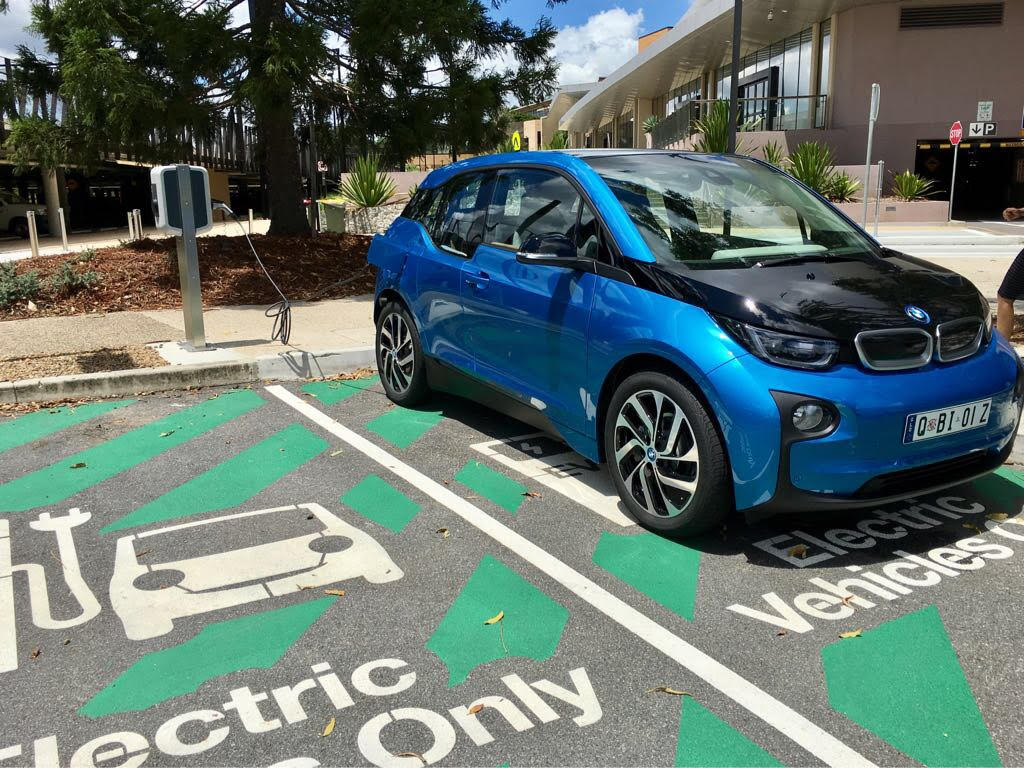
As a basic rule, most plug in hybrid vehicles (PHEVs) such as the Mitsubishi Outlander charger will charge at a maximum rate of 3.7kW, which will give you around 16km of range per hour charging. Most full battery electric vehicles (BEVs) such as the BMW i3 will charge closer to 7kW giving you around 32km of range per hour of charging. A common misunderstanding is that the car’s onboard charger is what determines a car’s charging AC charging capacity and not the EV charger itself, for example, if a PHEV was connected to a 7kW charger it will not increase the range per hour.
Currently Tesla (Model S & Model X) can charge at 16.5kW at three-phase, meaning they can charge faster than any other EV’s on the Australian market through an AC charger.
Given the EV market is developing along with the battery and charging technology, we recommend for businesses, corporate clients and local governments look at our 22kW Keba universal wallbox systems to provide the fastest future proof solution. The Keba 22kW universal wallbox will not only mean you can charge any EV on the road but that you will maximise your investment in EV charging technology through higher utilisation with a product that will remain viable for many years to come.
More information on 22kW Keba Universal Fast EV Charging Station